
Roof Leaks During Heavy Rain
Roof Leaks During Heavy Rain in Houston: Why It Happens and What to Do
A roof that stays dry in light rain and drips in a downpour is giving you clues. Here is how to read the pattern safely and what a roofer should check next.
Why does my roof leak only during heavy rain?
A downpour puts much more water on the roof than a light shower, and wind can push it sideways or uphill under shingle and flashing laps. Small gaps at flashing, valleys, pipe boots or a backed-up gutter may stay dry until that volume arrives. The source has to be confirmed by a roofer on site, because water often travels before it shows on a ceiling.
Houston can get heavy rain during thunderstorms and tropical systems, often with wind behind it. A roof with one small weak spot can handle a drizzle for years and still leak the first time a storm drives water at it from the wrong direction.
That pattern is frustrating, because the leak is gone by the time anyone comes to look. The good news is that the pattern itself is useful information. Here is how to record it safely and what it can point to.
In this article
Why a roof can stay dry in light rain and leak in a downpour
Shingles and flashing work by overlapping, so water runs down and off. Three things change in a heavy storm:
- Volume. More water reaches valleys, roof-to-wall joints and gutters than they normally carry. A valley that handles a shower can overflow its lap in a downpour.
- Wind. Wind-driven rain moves sideways and can be pushed up under laps, around the edges of flashing and through small gaps at vents.
- Backup. When gutters or downspouts cannot keep up, water can sit at the roof edge and work its way under the first course of shingles.
Because of this, a leak that appears only in heavy rain usually comes from a detail rather than from the open field of shingles: flashing, a penetration, a valley or the roof edge.
Keep a simple leak diary from inside and the ground
You do not need to go on the roof to collect good information. Wait until the storm has passed, then note what you saw from inside the house and from the ground.
| What to record | Why it helps |
|---|---|
| Date and time the water appeared | Shows how long into the storm the leak started |
| How hard it was raining | Separates downpour-only leaks from every-rain leaks |
| Wind direction, if you know it | Points to the side of the roof taking the water |
| Exactly where the water showed up | Gives the inspector a starting point inside |
| Whether it stopped when the rain stopped | Helps separate roof leaks from plumbing or AC water |
| Photos of the stain, drip and any wet items | Shows how the stain changes from one storm to the next |
Do not wait for another storm to seek help. Contact a roofer promptly about an active leak; share any notes or photos you already have. Notes from past storms can help the inspector, but they should never delay a call.
Six common heavy rain leak patterns and the right next step
These patterns come up often on Houston-area homes. They are starting points for an inspection, not a diagnosis.
| What you notice | Possible sources | Professional next step |
|---|---|---|
| Water on an inside wall below a second story | Step flashing or counterflashing where the lower roof meets the upper wall | Inspect flashing laps and siding at that wall |
| A drip near a bathroom or kitchen ceiling | A cracked or loose pipe boot on the vent pipe above | Check the pipe boot, its fasteners and the decking around it |
| A stain near a chimney or skylight | Flashing, counterflashing or the curb around the opening | Inspect each flashing layer and the sealant joints |
| Water at an inside corner of the house | A valley that overflows or has worn shingles | Check valley shingles, laps and any debris |
| Water along an exterior wall near the eaves | Gutters backing up under the roof edge | Check gutters, downspouts, drip edge and the first shingle course |
| A leak only when wind comes from one direction | Wind-driven rain at vents, ridge caps or lifted shingles on that side | Inspect the side facing the storm, including vents and ridge |
If the leak lines up with one of these, mention it when you call. It helps the inspector plan where to look first. Our guide to pipe jack and flashing leaks goes deeper on the penetration and flashing patterns.
Roof, plumbing, AC condensation or something else?
Not every wet ceiling during a storm is a roof leak, and not every roof leak waits for a storm. Some clues:
- Water that shows up on dry days often points to plumbing, an AC drain line or drain pan, or a water heater vent.
- Damp spots on humid summer mornings near vents or ducts can be condensation from ducts or poor attic ventilation.
- Water that appears only during rain and stops soon after usually points to the roof or the walls above the roofline.
None of these clues is certain. A roofer cannot confirm the cause from a photo, and a good one will tell you when what they find points to a plumber or an HVAC technician instead.
Wet ceilings, electricity and when to call for help
Safety comes before the leak diary:
- Keep people and pets out from under a ceiling that is sagging or bulging.
- Stay away from water near light fixtures, outlets or the electrical panel, and call an electrician or your electric utility.
- Call 911 for immediate danger, such as a ceiling coming down, smoke or sparks, or a power line on or near the house.
- Stay off the roof, especially when it is wet or storm damaged.
The National Weather Service advises waiting until severe weather has passed before checking your property, staying out of damaged buildings and reporting downed power lines to local authorities.
Why a quick surface patch can miss the source
Water that gets in at one spot can run along the roof deck or a rafter and show up feet away. A patch of sealant over the shingles directly above the stain can miss the real opening, and a layer of caulk can hide a failing part while water keeps reaching the wood.
A lasting repair starts with finding the opening and then replacing or reseating the part that failed, such as a pipe boot, a piece of flashing or a popped nail. In the video below, our team shows popped nails lifting flashing on a Pearland roof and why gasketed roofing screws hold better.
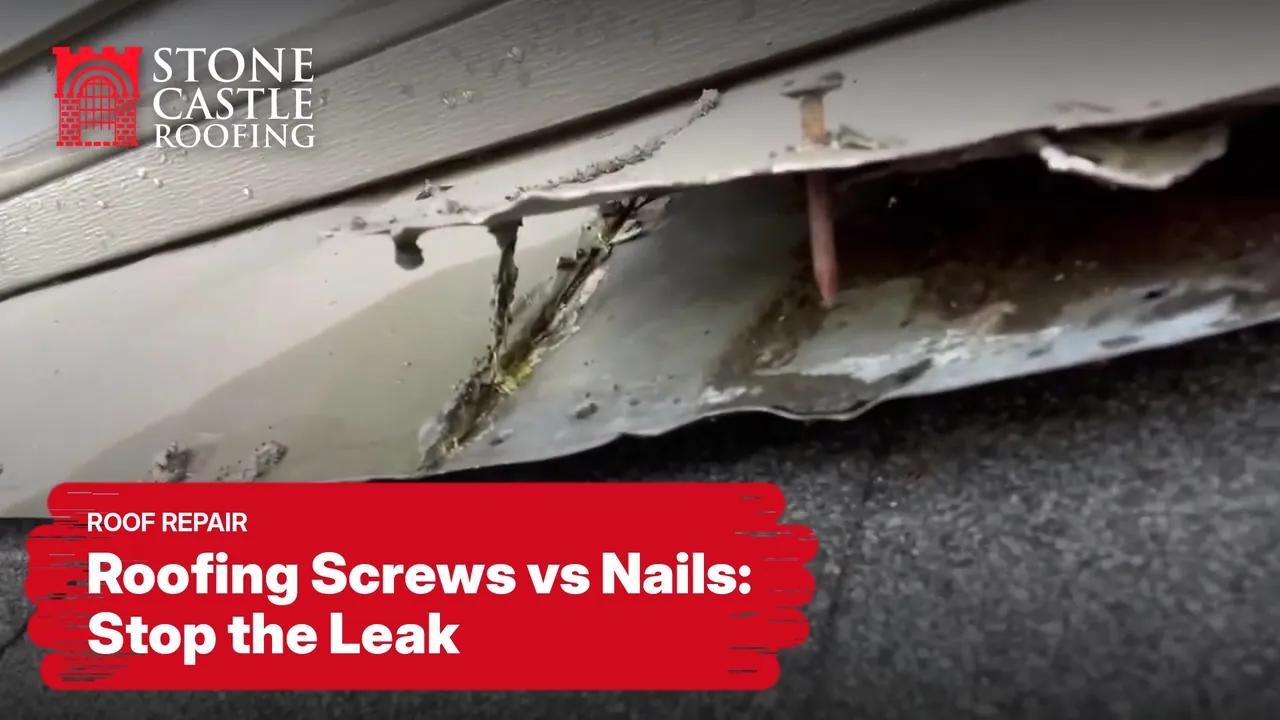
Roofing Screws vs Nails: Roof Repair and Maintenance in Pearland, TX
Read the transcript
Hey, guys. We're in Pearland, Texas, doing a roof maintenance, and I want to show you another example of why you need roofing screws. See how none of these nails have sealant on top? The nails have popped up and left this flashing sticking up. Over time, water gets in where the nails used to be and rots out the plywood. That's why roof maintenance is so important. If you don't have roofing screws, we put them in. A roofing screw has a rubber washer, so it doesn't even need sealant. It's a much better product. If you need roof maintenance, let me know. (281) 250-1265. Stone Castle Roofing.
Targeted repair, replacement and insurance
A single leak with a clear source on a roof with life left in it is usually a targeted repair. Leaks in several places, a leak that keeps coming back after repairs, or soft decking can make replacement the better use of money. Our guide on roof repair or replacement walks through that decision.
If the leak started after wind or hail, it may be part of an insurance claim. Whether it is covered depends on the cause of the damage and on your policy, and your insurance company makes that decision. Leaks from age or wear are generally treated differently from sudden storm damage. If you do file, you are responsible for your deductible. Our storm damage restoration page explains the documentation we provide.
Get the leak traced before it is patched
Stone Castle Roofing is locally owned in Pearland and serves Houston and nearby communities. Our roof leak repair service starts with tracing the source, photographing it and giving you a written repair scope. For other repairs, see our main roof repair page, or call (281) 250-1265.
Sources
- National Weather Service, What to Do After Severe Weather
- GAF, When to schedule a roof leak repair
Frequently Asked Questions
Yes. Wind can push rain sideways or uphill under shingle and flashing laps, around vents and through small gaps that stay dry in ordinary rain. These leaks often show up only when a storm comes from one direction, which is why noting the wind direction in a leak diary helps the inspector know which side of the roof to check first.
Water that gets past the roofing can run along the roof deck, a rafter or the top of the drywall before it drips. The stain shows where the water collected, not always where it entered. That is why a roofer traces the path from the stain back to the opening instead of patching directly above the wet spot.
No. Stay in a safe occupied area while the storm is active. After the storm has passed, you can look into the attic from the hatch only if it is safely accessible, without climbing in or walking across it, and only if there is no wet wiring or sagging, unstable ceiling nearby. Finding the leak is a job for the roofer.
A properly installed new roof should not leak in heavy rain. If it does, contact the contractor who installed it as soon as the storm passes and share your photos and notes. Common causes include a flashing detail at a wall or chimney, a pipe boot that was not seated correctly, or a valley that was not lapped properly.
It depends on what caused the leak and on your policy. Leaks from age, wear or missing maintenance are generally treated differently from sudden wind or hail damage, and your insurance company decides coverage and payment. If storm damage caused the leak and you file a claim, you are responsible for your deductible and any costs your policy does not cover.
Related articles
Pipe Jack and Flashing Roof Leaks in Houston: Causes and Repairs
Pipe jacks can be a source of roof leaks. Learn how they fail, how they differ from other flashing leaks, what a repair covers and why caulk alone is not a fix.
7 min read
Roof Repair or Replacement? How to Decide on a Houston Home
Not every roof problem needs a new roof. Use this decision guide on age, damage, leaks, decking, and insurance to choose between repair and replacement.
7 min read
Storm Damage Roof Checklist for Houston Homeowners
After wind, hail or a hard rain, a short checklist keeps you safe and organized. Use this one to log damage, book an inspection and know who does what next.
8 min read
About Stone Castle Roofing
Stone Castle Roofing is a locally owned roofing contractor in Pearland, TX, serving homeowners and businesses across Greater Houston. We are a GAF Certified Plus contractor and every project starts with a free roof inspection.