
Storm Damage Roof Checklist
Storm Damage Roof Checklist for Houston Homeowners
After wind, hail or a hard rain, a short checklist keeps you safe and organized. Use this one to log damage, book an inspection and know who does what next.
What should I check on my roof after a storm?
Once the storm has passed and it is safe, check from the ground and from inside only: shingles or debris in the yard, missing or shifted shingles, dented gutters and vents, and any new ceiling stains or drips. Photograph everything with the date. Stay off the roof, then book a roof inspection with photos and a written scope before deciding on a claim.
Hail in the spring, thunderstorms through the summer and tropical systems from June to November mean Pearland and Houston homeowners deal with storms often. The hours after a storm are confusing, and the knock on the door from an out-of-town crew can come quickly.
This checklist is meant to keep you safe and organized from the ground. For the full insurance claim process after hail, see our guide to hail damage roof insurance claims in Texas.
In this article
Safety first
Before you check anything:
- Wait until the storm has passed and stay tuned to local news or a NOAA Weather Radio for more storms.
- Stay away from downed power lines and report them.
- Stay out of any part of the house that is damaged or has a sagging ceiling.
- Wear long pants, a long-sleeved shirt and sturdy shoes when walking around debris.
- Keep away from water near outlets, light fixtures or the electrical panel. Call 911 for immediate danger.
- Do not climb a ladder or walk on the roof.
These steps follow the National Weather Service's advice for after severe weather, which also warns homeowners to watch out for insurance scammers after damage.
Start a photo log
A simple log turns a pile of phone photos into a record you can share with your roofer and your insurance company. The rows below are examples of how to fill it in.
| Date | Location | Observation | Photo file | Action |
|---|---|---|---|---|
| Storm date | Front yard | Shingle pieces on the lawn | IMG_0101 | Inspection requested |
| Storm date | Back gutter | Dents along the gutter face | IMG_0102 | Noted for inspector |
| Next day | Upstairs hall ceiling | New brown stain, dry to the touch | IMG_0110 | Bucket placed, roofer called |
| Next day | Driveway | Granules collected at the downspout | IMG_0115 | Noted for inspector |
Take wide photos first to show where you are, then close-ups. Keep the original files, because they hold the date and time.
Inside checks
- Ceilings and upper walls in every room, especially below valleys, chimneys, skylights and roof-to-wall joints
- Around windows and doors on the side of the house that faced the storm
- Closets, which are easy to miss
- The attic, only if the hatch is easy and safe to reach. Look from the hatch with a flashlight for wet insulation, dripping or daylight. Do not walk across it.
If you find water, move belongings, catch the drip and note the time. Our guide to roof leaks during heavy rain explains why a stain may not sit directly below the opening.
Outside checks from the ground
- Shingles, shingle pieces or ridge caps in the yard
- Missing, lifted or shifted shingles visible from the ground or an upstairs window
- Dents in gutters, downspouts, roof vents, window screens and AC fins
- Granules piling up at downspouts
- Branches or debris on the roof
- Damage to fences, siding, patio covers and cars, which shows how hard the storm hit
Owens Corning points out that hail is usually a widespread event in a neighborhood, so dents on cars and other items around the house can be a clue. Wind leaves different signs, which our guide to wind damage roof signs covers.
The video below is a hail inspection example from a Pearland roof, recorded on the roof by our team. It shows what hail impacts can look like close up. It is not evidence of damage from any particular storm or on any other home.
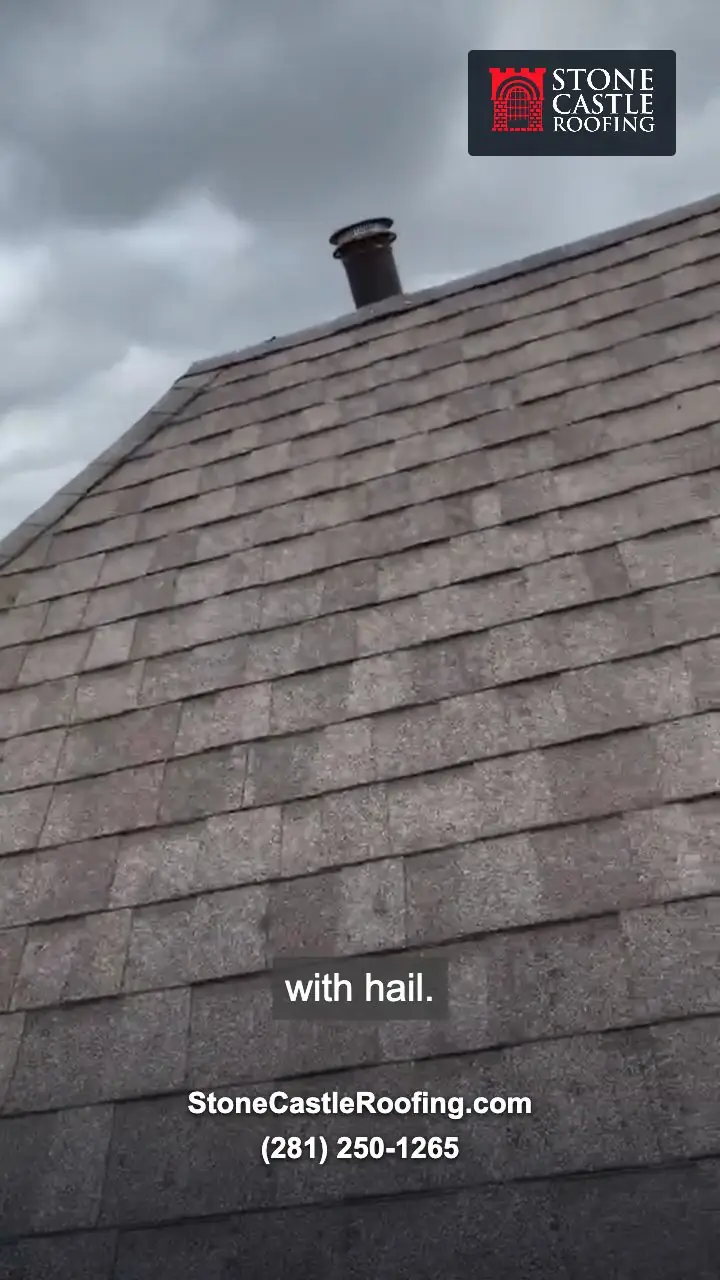
Hail Damage Roof Inspection in Pearland, Texas
Read the transcript
We are out here in Pearland again working these roofs. If you haven't had a roof inspection, please give me a call. I just want to show you all the extent of what this damage did. Look at that. That's all hail over there. This whole entire roof is just riddled with hail. Look at that. This is all here in the Pearland area so if you want a free inspection give me a call Stone Castle Roofing 281-250-1265.
Temporary protection, done by a professional
If water is coming in through an opening, the roof may need temporary protection such as a tarp. That is work for a trained roofer with fall protection, done once lightning and high wind have passed.
The Texas Department of Insurance notes that homeowner policies may require you to make reasonable temporary repairs to prevent further damage. TDI also advises keeping receipts, taking photos or video before repairs where possible, and not making permanent repairs until the adjuster has inspected the damage.
Book an inspection and get a written scope
A professional inspection confirms what you saw from the ground and finds what you could not see. Ask for:
- Photos of each damaged area, with an explanation
- Written findings on what is damaged and what looks like normal wear
- A written roofing estimate for the repair or replacement, if work is needed
- A note on whether a windstorm inspection may apply at your address
Stone Castle Roofing provides free roof inspections in Pearland and Greater Houston. You can learn how we document wind and hail damage on our storm damage restoration page.
Who does what: you, your insurer and your roofer
| Who | What they do |
|---|---|
| You, the homeowner | Read your policy, decide whether to file, file the claim, keep records of every call and pay your deductible |
| Your insurance company and its adjuster | Inspect the damage, decide what is covered and how much is paid |
| Your roofer | Inspect the roof, photograph damage, write a roofing estimate, meet the adjuster on site to explain the roofing findings when asked, and do the roofing work |
Texas law draws clear lines here. TDI explains that a roofer or contractor who may do the work cannot act as a public adjuster on your claim or advertise that they will, and that it is illegal for a contractor to waive, rebate or absorb your deductible. Your insurance company decides coverage and payment, and you are responsible for your deductible.
Questions to ask a roofer after a storm
- Do you have a local office address and phone number?
- Will I get inspection photos and written findings?
- Will you provide a written estimate before any work starts?
- Can you meet my adjuster on site to explain the roofing damage you found?
- How will you handle permits and any windstorm inspection my address needs?
- What deposit do you require, and when?
If a contractor offers to cover your deductible or pressures you to sign on the spot, walk away. Our guides to storm chaser roofer red flags and questions to ask a roofer before hiring go further.
Windstorm certification depends on your address
Windstorm rules are set by location, not by the storm. TDI's maps include all of Brazoria and Galveston counties in the designated catastrophe area, so most of Pearland, much of League City and the Galveston County part of Friendswood are inside it. In Harris County, only areas east of State Highway 146 inside the city limits of La Porte, Morgan's Point, Pasadena, Seabrook and Shoreacres are included, so most of Houston is not.
Inside the area, roof replacements and major repairs generally need a windstorm inspection and certificate of compliance to keep TWIA eligibility. TDI lists roof repairs of less than 100 square feet that do not involve decking among the projects that do not require one. Confirm what applies to your address and project with TDI or a qualified inspector, and read our guide to WPI-8 windstorm certification.
Next steps
- Keep everyone safe and stay off the roof.
- Fill in your photo log from inside and from the ground.
- Arrange temporary protection by a professional if water is coming in.
- Book a roof inspection and ask for photos, written findings and a written estimate.
- Read your policy and decide whether to file.
To schedule a free inspection in Pearland, Houston, Friendswood, League City or nearby, visit our storm damage restoration page or call (281) 250-1265.
Sources
- National Weather Service, What to Do After Severe Weather
- Owens Corning, Signs of Storm Damage on your Roof
- Texas Department of Insurance, Claim tips, Roofing and insurance: Know the law, Do you need a windstorm inspection? and Harris County windstorm boundary
Frequently Asked Questions
Make sure everyone is safe, stay away from downed power lines and damaged parts of the house, and stay off the roof. Once the storm has passed, photograph what you can see from the ground and from inside, with dates. Then arrange temporary protection by a professional if water is coming in, and book a roof inspection.
Take wide photos of each side of the house first, then close-ups of anything you notice: shingles in the yard, dented gutters and vents, debris on the roof and any ceiling stains. Keep the original files so the date and time are saved, and write down where each photo was taken. Do not climb onto the roof for photos.
The Texas Department of Insurance advises against making permanent repairs until the adjuster has inspected the damage, while noting that your policy may require reasonable temporary repairs to prevent further damage. Keep receipts and take photos before any temporary work. Temporary protection on a roof should be done by a trained professional.
No. In Texas, a roofer or contractor who may do the work on your home cannot act as a public adjuster on your claim. You file the claim, and your insurance company decides coverage and payment. A roofer can inspect the roof, photograph damage, provide a written roofing estimate and meet your adjuster on site to explain the roofing findings.
It depends on your address and the size of the job. In the TWIA designated catastrophe area, which includes all of Brazoria and Galveston counties and Harris County areas east of State Highway 146 inside the city limits of La Porte, Morgan's Point, Pasadena, Seabrook and Shoreacres, roof replacements and major repairs generally need one. Small repairs may not. Confirm with TDI or a qualified windstorm inspector before work starts.
Related articles
Wind Damage Roof Signs: A Houston Homeowner's Inspection Guide
Missing shingles are the obvious sign, but wind leaves quieter clues too. Here is what to check from the ground, what it means and what an inspection confirms.
7 min read
Hail Damage Roof Insurance Claim in Texas: A Step by Step Guide
What to do after hail hits your Pearland or Houston home: safety, photos, temporary protection, inspection, policy terms, the adjuster visit, and storm chasers.
8 min read
Storm Chaser Roofers: 9 Red Flags Houston Homeowners Should Know
After a Houston hail storm or hurricane, out-of-town crews show up fast. Learn the red flags of storm chaser roofers and how to vet a roofer in 10 minutes.
7 min read
About Stone Castle Roofing
Stone Castle Roofing is a locally owned roofing contractor in Pearland, TX, serving homeowners and businesses across Greater Houston. We are a GAF Certified Plus contractor and every project starts with a free roof inspection.